Alegre in Poland: Ten Years of History and a Bright Future
In 2016, a new industrial facility opened its doors in the Polish city of Wroclaw: Industrias Alegre. Within a few months, that facility would begin production, but at that point it was little more than a promise tied to Ford’s plans. They had to get that factory up and running, assemble a team, and prove that the company was also capable of producing well there—right from the very first shift. It was an intense and successful journey.
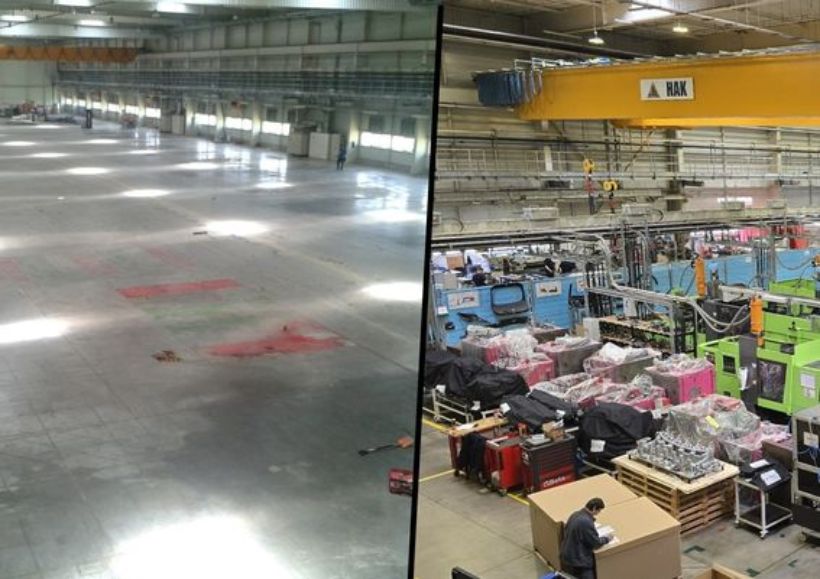
Ten years after its opening, the Industrias Alegre plant in Poland has changed its profile, its customer base, and its capacity. But the philosophy behind its founding has not changed: staying one step ahead of customer needs, bringing the latest innovations to market, and adapting when circumstances take an unexpected turn. That is why celebrating the 10th anniversary of the Wroclaw plant is far from an exercise in nostalgia—it is about reflecting on the journey so far and gathering momentum to face the future, which holds great promise.
A Shared Culture 2,400 Kilometers Apart
The plant began operations as part of Ford's programs. For Alegre, internationalizing its production meant moving closer to Central Europe, where many of the continent's major OEMs are based.
The facility began operations by producing interior parts for the Ford Fiesta. The following year, orders for the Focus started coming in. The team was still small, operations were highly focused, and the relationship with the sole customer was close. And as usual, the margin for error was zero—and that standard was met.
So in 2019, that factory—though small—could be considered a success because it had quickly and naturally embraced the culture of Industrias Alegre: rigor, closeness, and commitment to the process. The team, drawn from a wide variety of backgrounds (Poland, Ukraine, the Philippines), had quickly come together and demonstrated that a Spanish company could operate reliably 2,400 kilometers away from its headquarters.
That’s why, when Krzysztof Jarzyna, the subsidiary’s CEO, is asked about the most important achievement of recent years, he quickly replies: “The people. We’ve created a team spirit that’s entirely goal-oriented. You can feel it every day when you come to the plant.”
Diversification of clients and industries
Starting in 2020, however, the landscape changed. First came the pandemic, and then the semiconductor crisis. The automotive sector ground to a halt across Europe, and the Wroclaw plant lost virtually all of its workload overnight. But instead of waiting, the team sought out orders outside the automotive industry and found them in the home appliance sector. It then began manufacturing components for LG washing machines, with all that entailed: different materials, different production processes, and requirements and standards that were completely unlike anything they were used to.
But the plant held up. The team rose to the challenge. And that experience left us with a more seasoned, wiser team, confident in our ability to offer flexibility of immense value.
Based on that experience, the plant stepped up its efforts to diversify its customer base and the industries it serves—a process that has transformed its profile. In the automotive sector alone, it has gone from working almost exclusively for Ford to serving Volkswagen, Audi, Škoda, and Stellantis. It also serves some Tier 1 suppliers such as AD Plastik, Ufi Filters, and Yanfeng. From a single customer to eight; from serving two plants to supplying 33; from 18 active injection molding machines to 42. And it has maintained control of the process at all times—without ever abandoning the home appliance sector.
Technical complexity has grown at the same pace. Today, Wroclaw has capabilities that go far beyond conventional injection molding: gas injection molding for interior structural components, two-component processes for HEPA filters, overmolding onto aluminum, and—at the cutting edge—injection molding onto fabric, a unique capability that has enabled the plant to secure new contracts with European manufacturers and position itself for technically demanding projects.
Thanks to all of this, the Polish plant now manufactures components that combine aesthetic appeal, precision, and a high degree of automation.
What Lies Behind the Numbers
Taking a moment to reflect on the journey so far is inspiring. But what matters most is that it encourages us to keep moving forward. Because the plant still has room to grow. And because there’s a team ready to make that happen.
Wrocław looks to the future with its sights set on two areas.
First, it wants to reach automotive manufacturers who are not yet familiar with its capabilities. And in that regard, the electric vehicle sector is where its presence would make the most sense, since it requires fewer components—but ones with higher added value—and has stricter requirements. The plant is equipped to handle this sector.
He also wants to demonstrate that the capabilities built up over a decade are not limited to a single sector. The “white line” is no longer just a hypothesis. The key is to identify which other verticals are committed to excellence.
In any case, the Polish division of Industrias Alegre has the strongest argument there is: a decade of actual production.