Pawel Górski: “We change and improve all our processes every day”
He arrived alone. He had a practically empty factory, a clear assignment, and no coworkers nearby. It was early 2016, and Górski had just become the first person hired by Industrias Alegre in Poland to get its factory up and running. Ten years later, he’s still in the same position and has witnessed firsthand the growth of the factory into what it is today. Here are his thoughts.
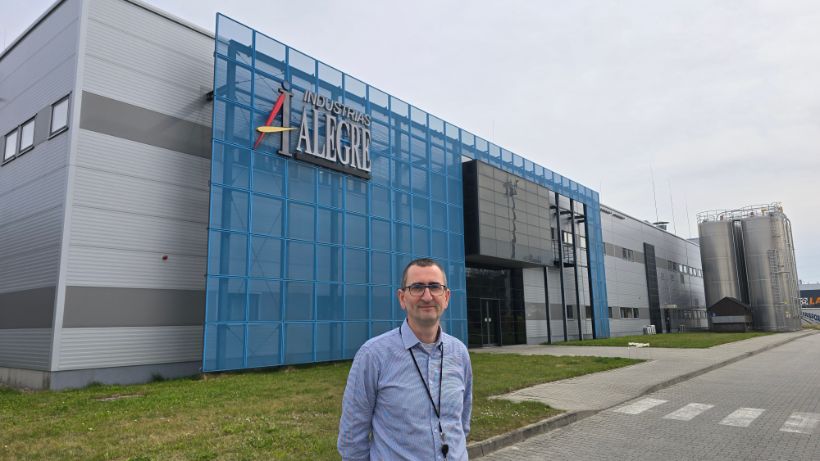
Górski has been responsible for maintenance at Industrias Alegre in Poland from day one. It was he who, working remotely and alongside Albal’s management team, designed the plan to get the factory up and running: he sought out the companies that would remodel the facilities, oversaw the complete renovation of the electrical system, and awaited the arrival of the first injection molding machines. No one is better suited than he is to describe what has changed and what has remained the same over the past decade.
How did you end up at Industrias Alegre? Did you know anything about the company before you joined?
I joined Industrias Alegre in early 2016, looking for a stable work environment in the automotive industry. I wasn’t familiar with the company beforehand, but I checked out its website and decided it might be what I was looking for. The position of maintenance manager was a good fit for my previous experience.
What do you remember about your first few days? What was the plant like back then?
I was the first person hired in Poland, so I arrived alone at a virtually empty factory and, working remotely alongside the Spanish management team, developed a plan to get the factory up and running from scratch. The building was already there, but all the technological infrastructure had to be replaced, including a complete overhaul of the electrical system that would power the future injection molding machines.
What were your responsibilities at the company back then? Are you still doing the same job?
I spent the first few days—even weeks—looking for companies that could rebuild all the facilities. Then, company management approved the bids, and the contracts were awarded to the various companies. This process took several months. At the same time, the Spanish headquarters was ordering new production machines. The first machines began arriving in late May 2016, and other colleagues joined me during that time. I remember the enormous workload and the emphasis on properly connecting and commissioning the machines and other technological equipment. Back then, the plant was in an early stage of development; today, I see tremendous progress in the organization and standardization of processes. I still hold the same position.
Was there ever a moment during those first few weeks when you thought, “This is going to work out,” or, on the contrary, “This is going to be hard”?
I didn't hesitate, since I had previously set up a similar system, built from scratch. I knew we had to succeed, especially because the commitment and support from headquarters were so important.
What has been the biggest change you've seen at the plant since you arrived?
I think the biggest change in recent years has been the level of maturity of our processes and the emphasis on quality and continuous improvement.
Have there been any difficult moments? How did you experience them from the inside?
The hardest times were during the COVID-19 pandemic, when we had to shut down the plant for an entire month and didn't know if we'd be able to return to work anytime soon. It was a really difficult time for everyone.
Have you noticed the team changing much? What, if anything, has remained the same?
Of course, I have seen significant growth in competition and quality awareness, while maintaining a high level of commitment. Everything and everyone is constantly changing, but by applying the principles of lean manufacturing (Lean Manufacturing), we constantly strive for excellence; there is never a point at which something cannot be improved. We change and improve all our processes every day.
Is there anything you've learned over the past ten years that you didn't expect to learn when you started?
Yes; one of the things I didn't expect at first was just how crucial not only technical skills but also organizational and communication skills are in maintenance.
At first, I focused mainly on repairs and troubleshooting, but over time I realized that failure prevention and process-oriented thinking—maintenance planning, root cause analysis, and collaboration with production—are essential.
I also learned a lot about how to work under pressure: when the production line stops, you have to act quickly, but you also have to make good decisions to prevent the problem from happening again.
What are you most proud of among the things that have been built here?
What makes me most proud is that we've managed to shift from a reactive, emergency-focused approach to a more preventive one: less downtime, better work organization, and greater production stability. I'm glad to have contributed to that.
I'm also proud of my team, which I built from the ground up and that has remained very stable for several years.
What can you do today that other providers in the area can't?
I believe our strength lies in combining practical experience with a process-based approach. We don't just focus on fixing a problem; we focus on identifying its root cause and implementing a solution that prevents it from happening again.
Explain to someone from outside the company what makes this team special
What sets our team apart is, above all, our excellent collaboration and mutual support, especially in crisis situations. When a problem arises, there are no divisions—just swift action and a focus on finding a solution.
Our approach also sets us apart: we don't just solve a problem; we strive to understand why it occurred and how to prevent it in the future.
This allows the team not only to respond effectively, but also to prevent problems more and more often.
Is there any story from those years that you think is worth sharing?
We had a recurring issue that could be quickly resolved each time, but we decided to investigate the cause. After a more thorough analysis, we were able to eliminate it permanently. This shows that, in this type of work, it’s crucial not only to react but also to think long-term.